

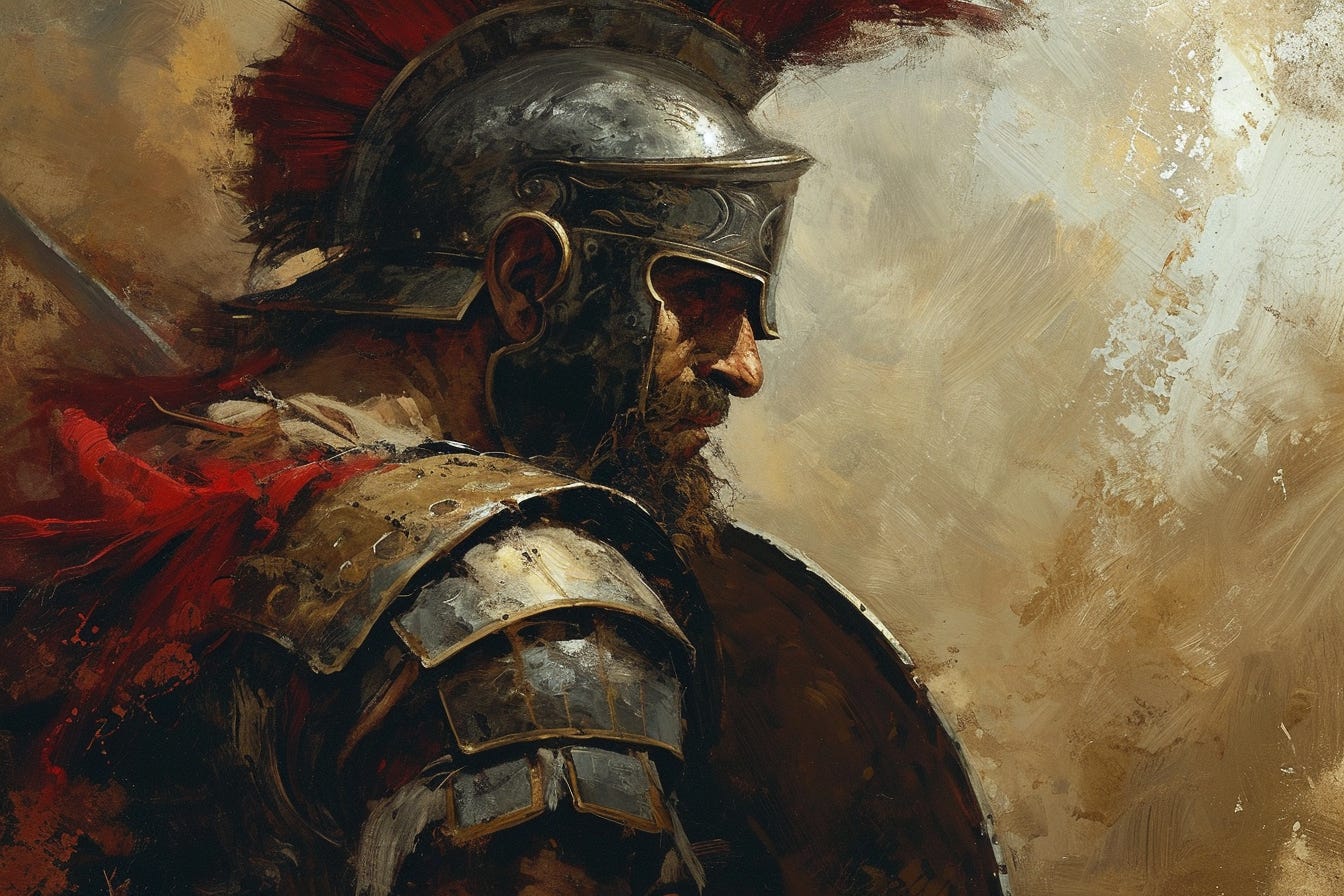
I’m seeing Achilles vs Hector making the rounds online, so this is an essay I wrote awhile back for secret project concerning the matter:
It is my deepest desire to see the return of TRUE heroism to mankind on the ultimate frontier. Think daring space rescues and exploration in the nothingness of the void, where man is forced to be what he was born to be. Many think they know what heroism is, but they have nothing but a warped view of the truth. The modern image of heroism is the Trojan warrior, Hektor. Hektor is a very relatable character to modern warriors. What he fights for is what soldiers today fight for: God, family, and country. Not only that, he’s put in a rock and a hard place, he must defend his brother who broke a sacred custom of the hearth and led a foreign army to his doorstep. His plight is not unlike modern soldiers who must follow orders no matter the circumstances. He stands as the best Troy has to offer against the raging fire of the Achaeans. And he does an exemplary job, worthy of the highest respect. I am certain the Greeks respected the man, but it would be a mistake of the highest degree to make Hektor the “hero of the Iliad.” Homer did not create the Iliad for Hektor. Homer did not have the values we moderns have. The reverence of Hektor today represents the inversion of morality. The triumph of the low over the high in man.
The Greeks did not admire what the moderns do in Hektor. Hell, most moderns don’t even understand character of Hektor. There is much to say about his skill as a warrior. He goes toe to toe with Ajax and fights him to a draw, for example. But he was not someone the Greeks had reverence for. The hero of the Iliad is Achilles. THIS is enough to send moderns in a rage over Achilles. How could Achilles be the hero? He wasn’t patriotic toward country like Hektor. He left the war over a slight against his honor by King Agamemnon. Achilles was the son of a Goddess whereas Hektor was just a man. The excuses mount up like a pile of dog shit. It is all but a sign of how morality has inverted over time. Before we get into WHY Achilles is the hero of the Iliad, let us give an example of Greek morality by a little known story of Herakles, before he was known as Herakles. His birth name was Alcides.
Barely a man, Alcides was the deciding factor in winning a generation long feud between his Thebans and their neighboring Minyans. The Thebans were forced to pay tribute to the Minyans for ten years after losing a war to them. Tributes came to collect what was owed to them, but Alcides had seen enough. He horribly mutilated the tributes. He cut off their ears, hands, noses, strung them into necklaces and sent the tributes packing — causing another war between the two peoples. This time around, however, Alcides dominated the Minyans and won victory for Thebes. The moderns would not find much fault with Herakles in this tale, maybe the mutilations weren’t necessary, but he “liberated” the Thebans from their debt. The story didn’t end there. Herakles imposed upon the defeated Minyans a similar debt, but doubled the portions and duration. What do you think about this? Would moderns agree? Would moderns think Herakles a hero after committing war crime against tributes and then, putting an even worse penalty on the Minyans? Would moderns be horrified to know that the Greeks thought this was just and right?
Can you take this little story and apply it to how the Greeks thought about the Iliad? Say what you will about Hektor, his brother committed a grave crime against custom. He stole another man’s wife and his treasure. On top of this, Troy would not surrender Paris for punishment. The Trojans deserved what was done to them. The Greeks believed this. Their destruction was just and right. Not only this, Hektor does not represent the modern hero described above. Most of these takes of Hektor as an honorable hero versus Achilles the selfish brat of a Goddess come from the film adaptation of Homer’s epic. Hektor is a skilled warrior. A worthy foe, but it’s worth noting that he avoided Achilles for the duration of the war. Even before Achilles’s withdraw from the fighting, any time he took the field, Hektor would flee behind the walls of Troy. Most like to talk about his Hektor was just a man, but he was the grandson of Zeus, the same Zeus that gave him the power to dominate the Greeks. He had a noble lineage. Zeus laments that he loves Troy in the Iliad and thought it just that maybe he wipeout one of Hera’s beloved cities as retribution. He had as much divine aid as any of the Greeks. The story of the Iliad is not just Achaean versus Trojan, it is Olympian versus Olympian. The Gods take sides.
Do you really want to make Hektor your ideal? Why? Because he fights for his family and country? Let’s look more into the true character of this man to reveal what he really is before the eyes of the Greeks. Moderns speak to his moment with his wife and young son as something to something to be celebrated, but even in this moment, Hektor tells you who he is. His mentality, who he is, is the same as the Greeks besieging his city. Had the roles be reversed, he would be outside of Sparta if he could. He wanted what all warriors of the time wanted. At this time in history, there were tangible benefits to being a warrior. The loot went to the warriors, not the government as in modern society. When a man went to war, he went to war after not just GLORY, but women, slaves, and treasure. He did not go to war for a measly wage like modern soldiers do. Nor did he represent the same class modern warriors do who are often seen as coming from poor or middle class backgrounds. Ancient warriors were aristocrats, the men of power in their societies. Hektor doesn’t do much lament the situation Troy finds herself in, he laments not being able to do what the Achaeans are doing: fighting, dominating, and acquiring loot and glory.
How could a modern turn a man such as Hektor into a hero? The hero is seen as the man who rises to the occasion, who beats the enemy against impossible odds. Hektor received such a moment. He was given a chance to face Achilles on the field. To stand for Troy and everything he loves. Achilles had returned to the field and had the Trojan army in full retreat. What did Hektor do? He ran. Ran three times around Troy, chased by Achilles. He had to be tricked by The Gods into fighting Achilles. And when he finally did, he was put squarely in the dirt, never to rise again. But this isn’t even the extent of Hektor’s failure in the Trojan War. Many like to attach the word “DUTY” to Hektor. He did his duty to the last(even though at the very end he turned coward and fled). Hektor did NOT fulfill his duty to Troy. Any man who says this does not understand ancient culture. Hektor FAILED in his duty.
The King of Troy was PRIAM. Priam must have been an extraordinary warrior in the ancient world. He had around fifty sons. But by the Trojan War, he had become elderly, unable to fight on the frontlines. He put his eldest and best son, Hektor, in charge of the Trojan armies. This would not standout as a red flag to the modern. It seemed like prudence, right? The old and wise rule, the young do the fighting, but did the Achaeans do the same thing? I alluded before to the idea that maybe Priam should have given Paris up to the Greeks for his crime. There is some historic precedent for this, though it is not an apples to apples comparison. Romans in the early republic turned over their traitor kids to the government, sending them to their death. Is this true patriotism? They believed in Rome OVER the lives of their children. Now, how many among you could turn over your son to certain death? Very few, most likely. We understand why Priam did not do this. Priam, after all, was the PATRICIAN of this family. The house father, not just of his family, but all of Troy.
Hektor, however, loathed Paris and wished that he had been turned over to the Greeks. Why didn’t Hektor retire his elderly father and turn over his brother to save Troy? There was historical precedent for this. House Fathers that had become too old, too senile, could be retired by their sons. There is even an example of this in Homer. Fighting on the other side was Laertes’ son, Odysseus, who sometime before the start of the Trojan War had retired his own father. Laertes had become too old to run Ithica the way it was supposed to be ran and Odysseus decided it was time to take the reins. He gave his father a little farm to manage and went on his way to war. Imagine a heroic Hektor doing this to Priam after Priam decided to fight the Greeks over Paris’ sins. Hektor, by doing what most Trojans wanted him to do, hands over the cowardly Paris, saving the other forty-eight of Priam’s sons, as well as, the cities of Troy and her allies. Now, we would not be able to read the Iliad today if he had done this, but Troy would have been spared its raping at the hands of the Achaeans. Read the way Hektor speaks about Paris and tell me he wouldn’t do this! What was Hektor’s ultimate failure? Was he a slave to custom or was he just a coward?
No, forget about this man, Hektor. We will talk about what TRUE HEROISM really is.